課程公告 Course Announcement
訪問學程課程 Visiting Scholar Course資本主義的擴張與剝奪:邊陲地區依賴理論的批判性檢視 Capitalism’s Expansion and Dispossession: A Critical Examination of Dependency Theory in Peripheral Regions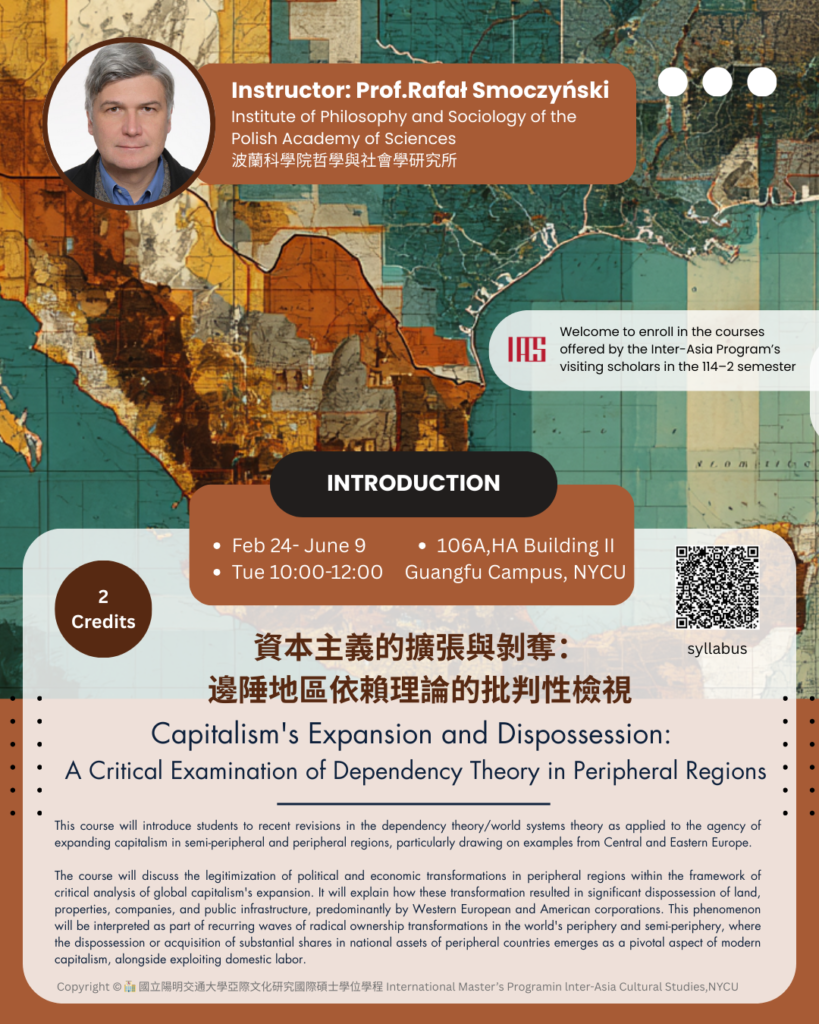
【Click here for Full Syllabus I 完整課程請點我】
- 學分 Credits: 2 credits
- 上課期間 Course Period: Feb 24- June 9, 2026 (Tue.) 10:00-12:00
- 教室地點 Classroom: 陽明交通大學新竹光復校區人社二館106A / 106A, HA Building II, Hsinchu Guangfu Campus, NYCU
- 開課單位 Course Offering Unit: 陽明交通大學亞際文化研究國際碩士學位學程 International Master’s Programin lnter-Asia Cultural Studies,NYCU
- 選課方式 Course Registration: NYCU Student ; NON-NYCU Student
——————————————————————————————————————
Instructor: Prof.Rafał Smoczyński
Institute of Philosophy and Sociology of the Polish Academy of Sciences, 波蘭科學院哲學與社會學研究所
課程概述與目標 Course descriptions and objectives:
This course will introduce students to recent revisions in the dependency theory/world systems theory as applied to the agency of expanding capitalism in semi-peripheral and peripheral regions, particularly drawing on examples from Central and Eastern Europe.
The course will discuss the legitimization of political and economic transformations in peripheral regions within the framework of critical analysis of global capitalism’s expansion. It will explain how these transformation resulted in significant dispossession of land, properties, companies, and public infrastructure, predominantly by Western European and American corporations. This phenomenon will be interpreted as part of recurring waves of radical ownership transformations in the world’s periphery and semi-periphery, where the dispossession or acquisition of substantial shares in national assets of peripheral countries emerges as a pivotal aspect of modern capitalism, alongside exploiting domestic labor.
Following critical theory it will be discussed how since the mid-twentieth century, capital expansion has increasingly manifested as indirect political control, facilitated by intricate instruments enabling acquisitions in previously closed markets, whether due to minimal asset valuations or structural imperatives driving such transactions.
Drawing on the case of Central Eastern European countries (Poland, Hungary, Slovakia, Czech Republic), this course will illustrate how the cyclic waves of expropriation were perceived as inevitable by the public, largely due to the legitimization of global capital expansion championed by dominant segments of CEE elites defined in the critical literature as the “comprador service sector.” It elucidates these processes of naturalization as reflective of the logic of dependent development, which bestows privileged social status
upon Eastern European elites, particularly through their mediating role essential to the interface between foreign capital owners and the indigenous population.
The course will emphasize a historical peculiarity of Central and Eastern European societies (especially Polish and Hungarian) where the bourgeoisie has been weakly established, and a high degree of foreign ownership of financial assets has dominated. Consequently, as will be demonstrated, a post-feudal intelligentsia stratum – the elite of cultural capital – has historically set the parameters of civic responsibility in this region. In explaining the semi-peripheral conditions of Central and Eastern Europe, the course will demonstrate how
political discourses surrounding this region often explicitly or implicitly refer to its dependent status in relation to the Western core countries. The part of the argument assumes that the modern CEE collective identity building has been significantly shaped by the discursive strategies of assessing CEE’s countries actual or imaginary state of the maturity as compared with the self-reported European “values” or “standards”, what has been determined by the dependent position of peripheral Central and Eastern Europe towards the core Western European countries. Additionally, the course will explore the distinction between the classic concept of orientalism as articulated by Said and its application to Central and Eastern Europe. Whereas Said’s notion of the Orient delineated a clear separation from Europe and emphasized fundamental differences, the position of East Central Europe remains ambiguous. It occupies a liminal space, both within and outside of Europe.
The boundary between Western Europe, considered the “true” Europe, and Eastern Europe is fluid, contested, and subject to numerous interpretations leading to stigmatization, exclusions and exploitation.
This course will explain also the legitimization strategies of social control associated with the rise of new digital industries and communication technologies in the 21st century. Specifically, it will lecture how the expansion of digital communication networks and social media platforms has influenced the social construction of moral panics targeting various economically worthless folk devils, thereby fostering a sense of ‘entrepreneurial subjectivity’ conducive to benefiting from a purportedly ‘fair’ neoliberal system that champions hardworking, autonomous citizens. The proliferation of claims-making surrounding moral panics is viewed here as cultural control mechanisms that serve to uphold a prevailing neoliberal social order. The course on public shaming in social media will be explained within a methodological framework known as ‘netnography,’ which investigates how shaming claims are propagated through the cyber-public sphere and online interactions to perpetuate certain citizenship model. Netnography examines how online shaming is susceptible to the claims-making activities of primary and secondary definers and how these claims are disseminated through online moral entrepreneurship associated with the construct of ideological normalization shaped by the parameters of economic efficiency, which are antagonistically confronted by the portrayal of ‘shiftless citizens’ allegedly disregarding the benefits of the neoliberal model. Within this context, different categories of Polish, Hungarian, Czech, Slovak, Romanian, Bulgarian citizens (often working-class members and farmers) are typically accused of lacking the ‘proper civilization competences’ necessary for European integration, modernization, open-mindedness, etc.
Upon the completion of the course students will be able to: (i) Use a range of approaches about the dependency theory/world-systems theory and have the ability to utilize them in critical analysis of a wide range of challenges related to complex contemporary societies; (ii) Critically assess the complexities of current power relations and analyse how these processes are shaped by uneven and contested strategies of global capital; (iii) Discuss the dimensions of current conceptual approaches to core-periphery relations. The course will be also an important stage in the development of the interdisciplinary skills of students. Contemporary social sciences increasingly require a more inter-disciplinary approach. |